
Project Structure
The project is organised into several work packages (WPs), each focusing on a specific topic or part of improving fish breeding for organic aquaculture.
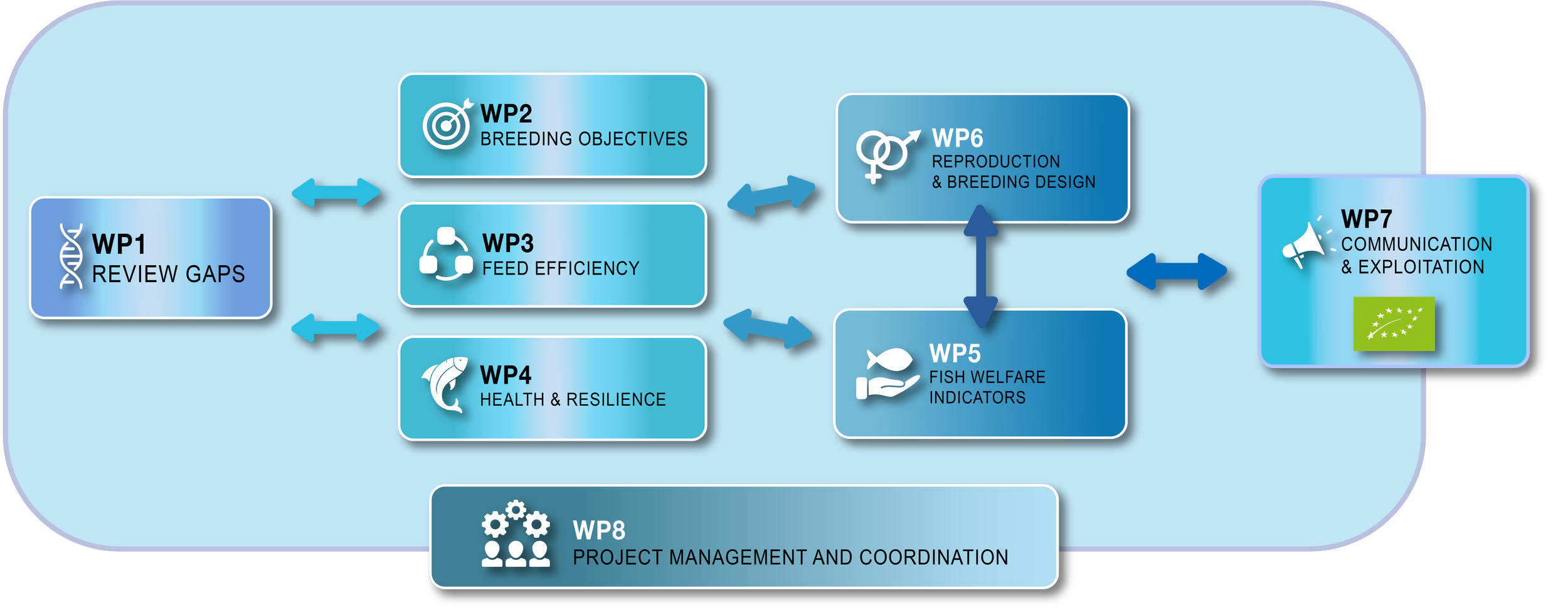
WP1 provides an up-to-date overview of breeding resources available in research and industry, and identifies what is missing or needs improvement to develop or allow for effective breeding programmes for organic fish farming in Europe.
Building on this foundation, the following work packages focus on practical solutions for different fish species:
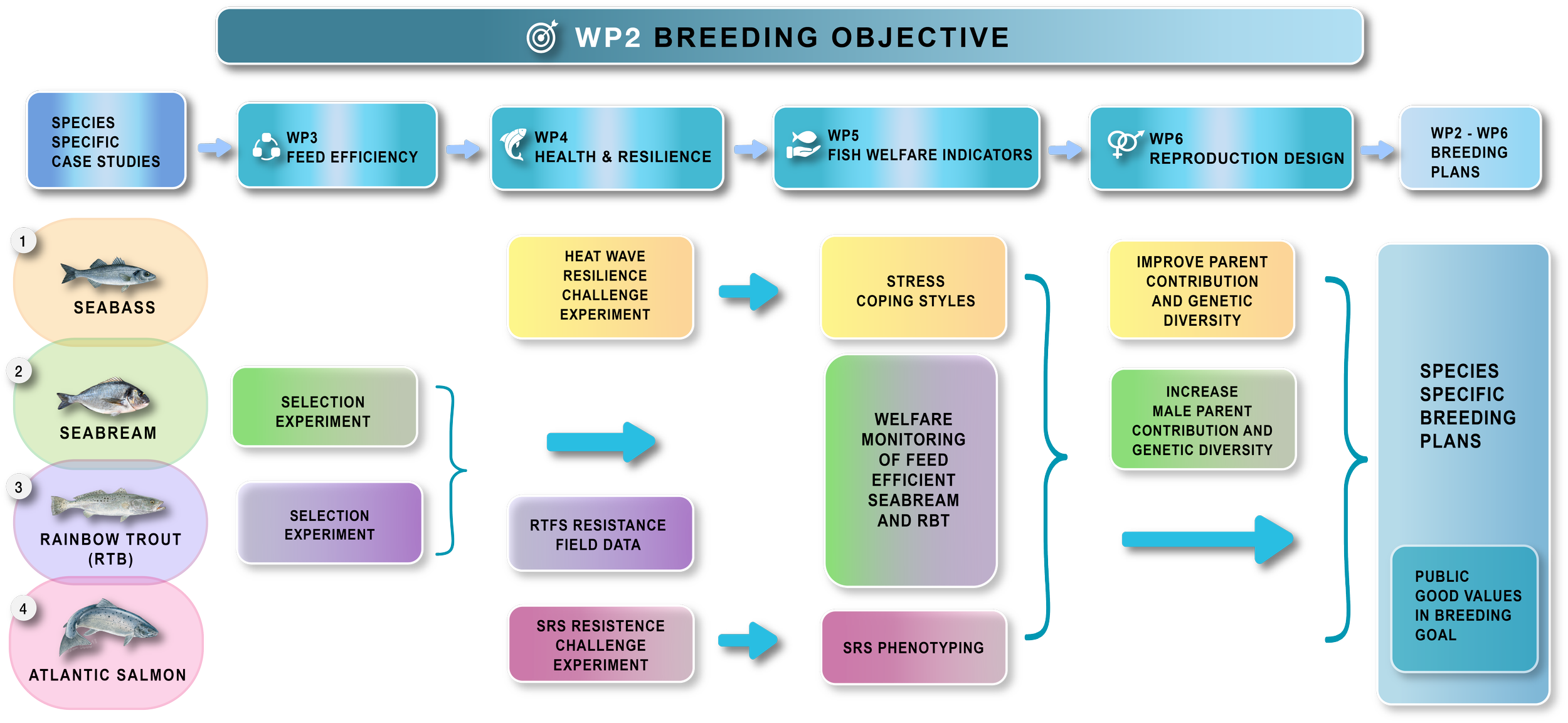
WP2 helps define clear breeding goals for organic aquaculture. It fills important knowledge gaps for the key traits in organic farming through research, testing, and demonstration activities, and sets the direction for future organic breeding programmes.
WP3 focuses on breeding fish that can use feed more efficiently, especially feeds made with alternative organic ingredients, while maintaining fish welfare. This helps reduce reliance on limited natural resources and allow for climate and environmentally friendly feed sources.
WP4 and WP5 study new traits that are especially important for organic farming, such as resistance to heat stress, and bacterial disease, as well as animal welfare. These work packages also help understand how these traits are inherited together from one generation to the next.
WP6 develops suitable reproduction methods and breeding strategies and plans that meet organic standards and can be realistically applied by fish farmers breeders and their companies.
To reduce the number of fish used in experiments and keep costs down, the project combines efforts across work packages. For example, WP5 works closely with WP3 and WP4, focusing on key health and welfare indicators for each species. Fish selected for better growth and feed efficiency are studied in seabream and rainbow trout, while resistance to disease and heat stress is tested in Atlantic salmon, rainbow trout and European seabass.
WP7 ensures that the knowledge generated across the project reaches the people who can use it. This work package focuses on communication, dissemination, stakeholder engagement, and exploitation. Its goal is to maximise the impact and uptake of SelectOrganic’s results during and after the project. WP7 supports the practical use of the newly developed selective breeding programmes for organic aquaculture—covering salmon, rainbow trout, seabass, and seabream—helping improve species resilience, disease resistance, and resource efficiency in line with the European Green Deal and the EU Biodiversity Strategy.
Overall, the project will deliver practical knowledge, tools, and strategies to support organic fish breeding. These results will help integrate animal welfare, sustainability, and efficiency into cost-effective breeding programmes for organic aquaculture in Europe.
Work Package Leaders
WP1 - Reviewing of Gaps
WP2 - Defining breeding goals for organic production systems
WP3 - Improvement of resource efficiency
WP4 - Fish health and resilience
WP5 - Testing and applying indicators for welfare monitoring and optimisation
WP6 - Develop reproduction and breeding designs to optimize and plan breeding programs for maintenance of genetic diversity
WP7 Communication, Dissemination, Stakeholder Engagement and Exploitation
WP8 Project management